
Valve (tube) guitar amplifiers produce their signature harmonic richness, compression, and dynamic touch response when their power tubes and output transformer are pushed hard. The practical catch is volume: a 50-watt or 100-watt tube head pushed into power-stage saturation is often far too loud for bedrooms, home studios, mic’d stage plots, or intimate venues.
A power attenuator sits between the amplifier’s speaker output and the speaker cabinet, absorbing part of the electrical power so the amp can be driven harder while lowering acoustic output at the speaker.
Advantages of Using a Power Attenuator
Power-tube saturation at manageable levels: You can push non-master-volume amps (such as vintage-style plexis, non-MV Vox-style circuits, or early Fenders) and master-volume amps into power-stage breakup without blowing out the room.
Consistent touch sensitivity and feel: Pushing the output stage naturally compresses peaks and blooms sustain in a way preamp gain or overdrive pedals rarely replicate identically.
Practical stage and studio control: Sound engineers can get stage-ready amp saturation at controlled stage volumes, or you can record a loud, saturated cabinet at lower room levels without phase bleed overwhelming nearby microphones.
Expanded recording and routing options: Many modern attenuators include line outputs, reactive load capability for silent/direct setups, or effects loops placed after the main amp’s power stage.
Disadvantages and Trade-Offs
Tone shift and high-end/low-end loss: Basic resistive attenuators do not behave identically to a real loudspeaker across frequencies, often dulling top-end sparkle or thinning low-end punch as attenuation increases.
Missing “Fletcher-Munson” acoustic weight: Even when frequency balance is preserved electronically,human hearing perceives less low-end and treble punch at low decibel levels—and a quiet speaker cabinet does not move the same air as a loud one.
Cost, weight, and extra cables: Quality attenuators add meaningful expense, extra rack or floor space,heat dissipation requirements, and additional speaker cables where a wrong connection or impedance mismatch can risk amp damage.
Faster valve wear when cranked: Running your amplifier hard all the time still subjects power tubes and filter components to higher thermal and electrical stress than running it clean or moderately driven. Output valve is shorter when using an output attenuator.
Spotlight: The Fryette Power Station PS-100
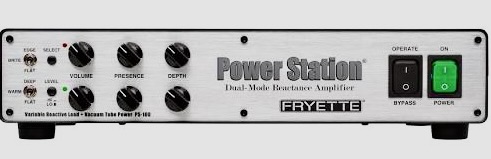
The Fryette Power Station PS-100 approaches power attenuation differently from a traditional resistor box.Rather than merely burning off excess wattage with fixed resistance, it pairs a variable reactive load with a dedicated 100-watt valve power amplifier (driven by a pair of 6550 power tubes alongside preamp/phase-inverter valve circuitry).
How the PS-100 Improves on Traditional Attenuators
Reactive load plus tube re-amplification: Your main amp sees a reactive load engineered to mimic speaker interaction, while the PS-100’s own 6550 valve stage rebuilds the signal at whatever volume you set. This helps preserve dynamic feel and harmonic life even at quiet practice levels.
Onboard Presence, Depth, and voicing switches: Because volume reduction can still alter perceived weight and edge, the PS-100 provides Presence and Depth controls plus Flat/Brite/Edge and Flat/Warm/Deep voicing toggles to tailor the power stage to your cabinet and room.
Dual footswitchable A/B settings: Two independent control sets (Volume, Presence, and Depth) let you switch between a quieter rhythm level and a louder solo/lead level on the fly.
Post-power-amp effects loop: Putting time-based and modulation effects in the PS-100’s series loop keeps delays and reverbs cleaner than running them through a heavily overdriven front end.
Silent load and power-amp boost versatility: It can act as a reactive load with line outputs (including XLR and unbalanced line out) for direct/silent setups, or as a 100-watt valve power amp to boost low-wattage heads, preamps, or amp modelers into a larger cabinet.
Where the PS-100 Still Has Caveats
Even a flagship unit like the PS-100 is not a magic eraser for physics. At very low bedroom volumes, a guitar speaker still lacks the physical air coupling of a loud cab, and adding another tube device means another piece of gear to power, ventilate, and cable properly. At roughly 15–16 lbs (around 7.3 kg) with a 150W–200W continuous reactive load rating depending on impedance, it is built for serious rigs—and costs significantly more than a simple passive attenuator
Finally
The Fryette power station uses two matched JJ 6550 ‘s and a balanced ECC83S. We sell this as kit and you can check it out by clicking here.